NBKA among the ten research teams at Patient’s Den
Photo by Maritime SPOR
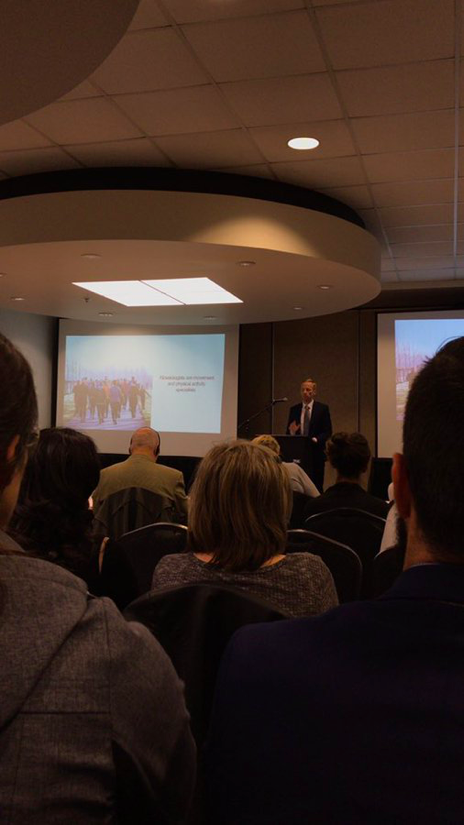
On October 3rd, the 2nd annual Patients’ Den was held in La Salle Richelieu on the Université de Moncton campus. The event saw 10 research teams pitch their research projects that have to align with NB Primary and Integrated Health Care Innovation priorities. Among those 10 research teams, Professor Grant Handrigan from Université de Moncton presented his project in collaboration with the New Brunswick Kinesiology Association.
As part of this short presentation, Professor Handrigan also promoted kinesiology as a viable health profession as part of an integrated health care solution.
This event was facilitated by the honourable Ginette Petitpas Taylor, Member
of Parliament for Moncton-Riverview-Dieppe and the federal minister of health.
Professor Handrigan unfortunately did not receive the funding for the
proposed project, but nonetheless this was a great opportunity for
kinesiologists in New Brunswick to promote their work and present themselves as
a health profession.
We would like to thank Professor Handrigan for his implication and his time in promoting kinesiology in New Brunswick.
Where:University of New Brunswick,
Fredericton; Kinesiology Building.
Why: To showcase student research in the
field of Kinesiology.
Who: All students associated with research
conducted in the field of Kinesiology.
Eligibility Criteria:
All university students
presenting research associated with the field of Kinesiology are eligible.
Posters can be a
research project, your thesis or dissertation research. Work in progress
will also be accepted.
Posters must be produced
by the student and the student must be first author. Only the first author
will be eligible for a prize. If more than one student will be on the
poster, it will be the responsibility of the first author to distribute
the prize.
Students may be on more
than one poster however, only one poster with the student as first author
will be considered for a prize.
Process:
Complete no more than a 500-word
abstract of your work and submit by
Monday, September 23rd.
Prepare your research
poster. Posters should be 36″ by 48″. Poster printing will not be
provided.
Arrive at 8 a.m. to
place your research poster on the assigned poster board. Please see
volunteers to receive your assigned board number.
Abstract Format:
Submit
a Microsoft Word Document; Times New Roman, size 12 font, with the following
guidelines:
First Line: The Primary Author/Presenter, with cycle
(undergraduate, master, doctorate) and year (1st, 2nd, 3rd)
of study.
Second Line: Tile of the Presentation
Third Line: All of the Authors in the Research
Fourth Line: Any Affiliations of Authors
Fifth Line: Abstract
Please submit all information with your conference registration form completed (available in September) no later than September 23rd to:
The New Brunswick Kinesiology Association is proud to offer its first student bursary. The bursary aims to financially support university students who are pursuing a degree in kinesiology at a New Brunswick university.
Scholarship Amount:
$500
Eligibility:
Undergraduate student pursuing a degree in Kinesiology at the University of New Brunswick or the Université de Moncton.
Member of the New Brunswick Kinesiology Association (NBKA)
Submission Guidelines:
The application should be formatted as a PDF, including:
Cover Letter
Resume
An essay (maximum 2 pages) explaining:
Interests and motivations for pursuing studies in kinesiology,
Current plans for the future following graduation,
Why you should be chosen to receive this bursary.
The PDF file with the complete application should be
emailed to nbkaaknb@gmail.com by September 23, 2019. The award recipient will be
announced at the annual NBKA/AKNB conference on October 5th, 2019 in
Fredericton, NB.
The NBKA aims to provide financial support to a student at a New Brunswick university, and hopes to aid them in reaching their education goals and to pursue a future in a kinesiology related field.
We look forward to receiving all of your applications!
Not a Student Member yet? Fill out an application to become a student member of the NBKA. Student memberships are free of charge.
*Notre site web en français est présentement en construction. Vous pouvez tout de même consulter cette publication en français en consultant le lien suivant: Bourse 2019 – Guide de Soumission
In 2016, the Canadian Society for Exercise Physiologists (CSEP-SCPE) launched the first movement guidelines for 24 hours aimed at children and youth between the ages of 5 and 17. An overview of the 2018 report card on physical activity for children and youth of ParticipACTION showed 62% of 3 to 4-year old’s and only 35% of 5 to 17-year olds were reaching their recommended physical activity levels as outlined in the Canadian 24-hr Movement Guidelines for Children and Youth. It was also noted that 21% of children typically used an active mode of transportation for commuting.
The Canadian 24-hour movement guidelines for children and youth (1), state that children should adopt an active lifestyle with a focus on finding balance between physical activity, sedentary behaviours and sleep in order to ensure their healthy development. Here is a profile of the youth from New Brunswick with regards to each of these activities, based on the provincial and national data that are currently available .
PHYSICAL ACTIVITY PARTICIPATION
Youth between the ages of 5 and 17 should accumulate at least 60 minutes of physical activity per day, including a variety of aerobic activities. In addition, high intensity activities and activities that rely on muscular strength should be performed at least three times per week (1). These recommendations stipulate that youth should be performing at least 7 hours of activity per week. In New Brunswick, 26.6% (26.2% in Canada) of youth aged between 6 and 11 and 32.7% (21.4% in Canada) of youth aged between 12 and 17 (Figure 1) do not meet these recommendations, based on data retrieved from Statistics Canada in 2015 (2).
Other data are also available for
physical activity guidelines for youth in New Brunswick. First of all, if we
look at a questionnaire on the well-being of New Brunswick primary school aged
students, specifically kindergarten to grade five students in 2016-2017 (3),
77% of the respondents in the 4th and 5th grades reported
not achieving at least one hour per day of physical activity. However, the
parents for this same age group reported that only 21% of the children aged 5
to 11 (kindergarten to 5th grade) did not meet the minimum
recommendations. What’s more, 11% of students in this group practice active
transportation methods to get to school. For the older students, those in grade
6 to grade 12, it is 78% who report not meeting the minimum recommendations for
physical activity. Regarding active transportation methods, it is only 7% of
these students that regularly travel to and from school this way. There are a
slightly higher percentage who practice regularly a mix of active and inactive
methods of transportation.
The Canadian Fitness and Lifestyle
Research Institute (5) used pedometers to measure the number of steps taken in
a day in order to examine the physical activity levels of youth. They report
that for children between ages 5 and 19 years on average stepped 10 400 steps
per day, which is slightly less than the national average of 11 300 steps per
day. In comparison to the other provinces and territories, New Brunswick ranks
just ahead of Newfoundland and Labrador for average steps taken in a day, with
an overall rank of 12th place. In general, youth from the Atlantic
provinces perform fewer daily steps than the average Canadian youth. New
Brunswick shows the same tendency as across Canada with boys performing on
average more daily steps than girls. Also, as it is across Canada, youth who
move more generally come from households with higher revenues and are involved
in more organised sporting activities. Finally, this study indicates that the
number of steps taken daily decreases with age, and this for both New Brunswick
as well as the Canadian average.
SCREEN TIME
Screen time (watching television, gaming, using a computer, a tablet or any portable electronic device) should be limited to a maximum of 2 hours per day between the ages of 6 and 17. Also, prolonged sitting should also be limited (1). Continuing with New Brunswick, 26.5% (29.4% in Canada) of children aged between 6 and 11 and 71.2% (68.9% in Canada) aged between 12 and 17 (Figure 2) do not meet these recommendations (6). Based on the questionnaire on the well-being of New Brunswick primary school aged students, it is 57% of the respondents between ages 5 and 11 who spend more than 2 hours per day in front of a screen (3). For those aged 12 to 17, 63% of the respondents spend more than 2 hours per day (4).
SLEEP
Children between ages 5 and 13 are recommended to sleep between 9 to 11 hours per night, youth aged 14 to 17 should sleep between 8 to 10 hours per night. In New Brunswick, it is approximately 6 youth in 10 who sleep less than 8 hours per night (7). Continuing with data from the questionnaire on the well-being of New Brunswick primary school aged students (3,4), 39% of students between the 6th and the 12th grade sleep less than 8 hours per night. Data are not available for students between kindergarten and 5th grade.
This is alarming data, and if we look further, we can find
what influences kids to adopt a sedentary lifestyle. Let’s look at a non-exhaustive
list of determinants of change that bring a decrease in sedentarity for kids:
A decrease in the number of screens in the household (8)
A decrease in sedentary parents’ behaviour(8)
Reducing parents’ weekend screen-time (9)
Increasing family participation in sports or recreation (observed in boys))(9)
Promoting freedom to play outside (observed in girls)(9)
For active transportation, the distance between the home and school was one of the most important determinants of a child’s active transport to school. However, even if the kids live in proximity of their school, not all of them would use active transport to commute to school. A determinant that was more associated with children’s active transport was their parents’ use of active transport. “Monkey see, monkey do.” Furthermore, parents that had safety concerns about their neighbourhood had less active children which included active transportation.(10)
Move in family, promoting free outside play, and
reducing screen-time for children and parents is one part of the equation in
reducing children sedentarity. However, they are concrete solutions that can be
rapidly implemented within the family.
The surveys of the well-being of New Brunswick youth contain many other data on different dimensions of well-being, including nutrition, mental health, leisure activities, and others. You can consult these reports, and others, on the New Brunswick Health Council website (https://www.nbhc.ca)